



Cyber security | 05 May 2026
Building Clearer Visibility of Vulnerabilities Across Legacy and Modern Assets
Published by Asset Guardian
Industrial environments often contain a mix of legacy and modern assets, making vulnerability visibility difficult. Clearer insight helps teams understand exposure, prioritise risk, and strengthen cyber resilience without disrupting operations.
Vulnerability management in industrial environments presents a unique challenge. Unlike traditional IT estates, IACS environments often include long lived assets, proprietary technologies, and systems that were never designed with cyber security in mind. As a result, gaining a clear and consistent view of vulnerabilities across the estate can be difficult.
This challenge is amplified in environments where legacy and modern assets coexist. Newer systems may support more advanced security monitoring, while older equipment relies on limited or indirect insight. Without a consolidated view, organisations may struggle to understand where risk truly sits.
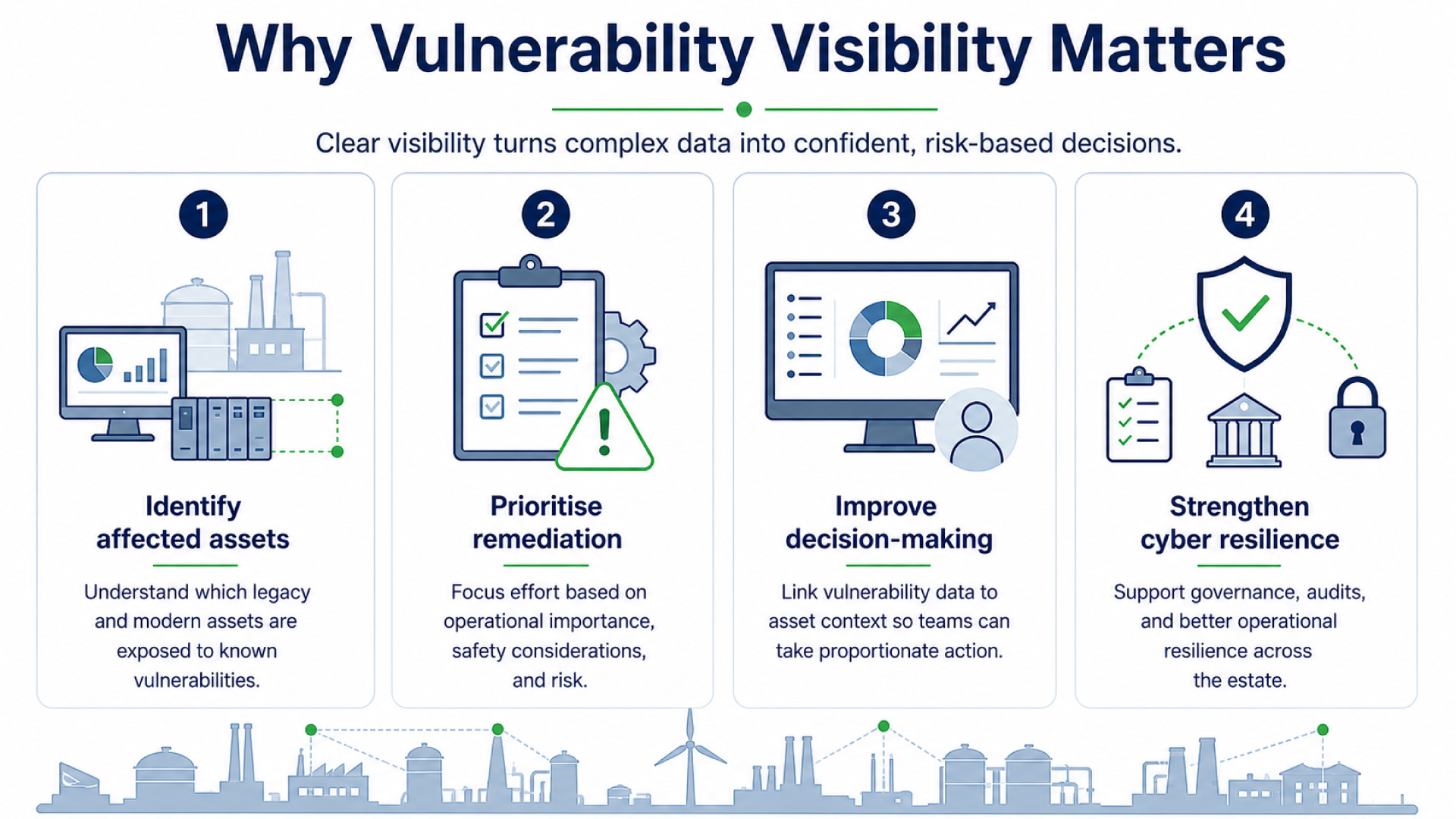
Why Vulnerability Visibility Matters
Effective cyber resilience depends on understanding exposure. When teams lack visibility of vulnerabilities across their assets, it becomes harder to prioritise mitigation, assess operational impact, or demonstrate control during audits and reviews.
Limited visibility can lead to:
- Uncertainty about which assets are affected by known vulnerabilities
- Difficulty prioritising remediation efforts
- Over reliance on assumptions about legacy system risk
- Reduced confidence in regulatory and governance discussions
These issues often stem from information gaps rather than technical failure.
Common Challenges in Mixed Asset Environments
In many organisations, vulnerability data is spread across multiple sources. Security tools, vendor advisories, asset inventories, and maintenance records may all hold partial information, but rarely provide a complete picture.
Common challenges include:
- Legacy assets with limited vulnerability reporting capabilities
- Inconsistent tracking of software versions and configurations
- Fragmented ownership between engineering, maintenance, and OT security teams
- Difficulty linking vulnerabilities to operational criticality
Without alignment, vulnerability management becomes reactive and difficult to scale.
Improving Visibility Without Disrupting Operations
Building clearer vulnerability visibility does not require organisations to treat OT environments like IT networks. Instead, it involves improving context and coordination across existing processes.
Practical steps may include:
- Maintaining an accurate inventory of assets, versions, and configurations
- Linking vulnerability information to specific assets and operational context
- Consolidating inputs from vendors, advisories, and internal assessments
- Prioritising vulnerabilities based on operational and safety impact
- Ensuring vulnerability insight is shared across relevant teams
These approaches help teams move from fragmented awareness to more structured understanding.
Vulnerability Visibility and Cyber Resilience
Clearer visibility supports better decision making. When organisations understand where vulnerabilities exist and how they relate to operations, they can take proportionate and informed action. This strengthens resilience without introducing unnecessary disruption or risk.
In complex IACS environments, resilience is built through understanding and control, not just technology. Improving vulnerability visibility is a foundational step in supporting secure, reliable, and well governed operations.
Asset Guardian supports organisations in building clearer visibility of vulnerabilities across legacy and modern assets, helping teams strengthen cyber resilience while respecting the realities of industrial operations.